2021-07-31
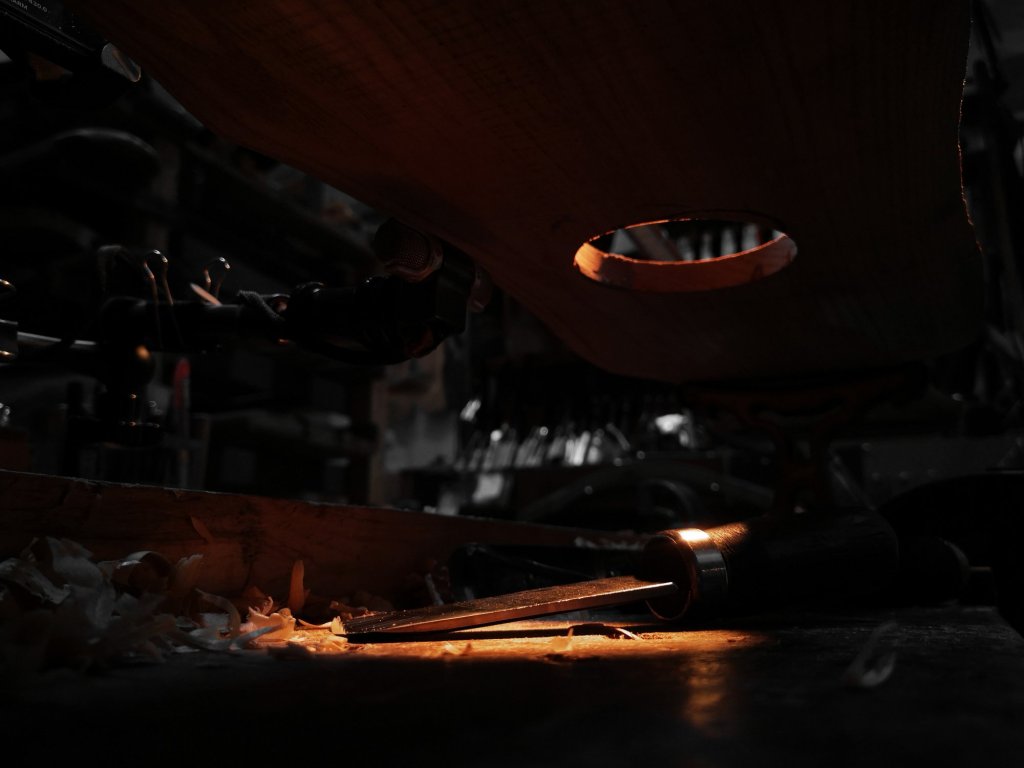
蕉葉琴底板精细调音
對於蕉葉琴特殊的外形約束下,古琴面板的厚薄分佈既要基於古琴獨有的諧振框架,更要因應蕉葉琴複雜外形而
常規的古琴發聲中,面板以中音與中高音為主音低音為副音,底板則以低音為主音中音為副音,彼此交融而成我们能听见的琴音。所以底板與面板的調音相輔相成,並且整體音色在兼顧古琴七根弦的拉力結構同時以等量均衡為調音宗旨。
而蕉葉琴的底板調音會因應面板響應頻率而進行互調。例如一張琴的自然频率橫跨CDFGA調,假設面板為D與F為主調,底版則可以調整自然频率在32Hz左右,即可以以C與A為主調。但在某種情況下也可以讓面板與底板音調互換或對調,而在等响度曲线上可以理解为调整高低音交接位置的衔接与比例。
蕉葉琴調音可以在合琴後因應音色誤差而在後期進行修正,所以相對常規古琴更為靈活但操作難度也會稍高。而雁足裝配也可以根據當前面板與底板的音色過渡情況而選擇提前或延後進行雁足插槽雕刻。
Backboard fine-tunning of the Jiaoye Qin’s
In the regular form (shape) of Qin sound, the soundboard uses the midrange as the main tone and the bass as the sub-tone, and the backboard uses the bass as the main tone and the mid-range as the sub-tone, blending with each other form the Qin sound that we can hear and feel. Therefore, the tuning of the backboard and the soundboard complement each other, and overall the tone is balanced with the structure of seven-string tensionwhile taking equal balance as tuning the Qin tone even the timbre.
The backboard tuning of the Jiaoye Qin’s will intermodulate according to the natural resonance frequency of the soundboard. For example, the resonance frequency of Qin across the CDFGA tone. Assuming that the panel has D and F as the main tones, the backboard can adjust the resonance frequency to about 32Hz, that is, C and A can be the main tones. In some cases, the tone of the soundboard and backboard can be interchanged or switch, and the equal loudness curve can be understood as adjusting the connection and ratio of the high and low pitch of Qin tunning.
The Jiaoye Qin can be correct in the later stage according to the tone deviation after the soundboard and backboard bonding, so it is more flexible than the regular Guqin but the operation difficulty will be slightly higher. The “Goose feet" (the endpin feet) part can also choose the slot carving in advance or later according to the tone transition of the current Qin (each of soundboard and backboard).
 {紫雲古琴斵製技藝坊}The Guqinuthiery & Workshop. Since 2014.