

2021-07-11
蕉葉琴面板精細調音
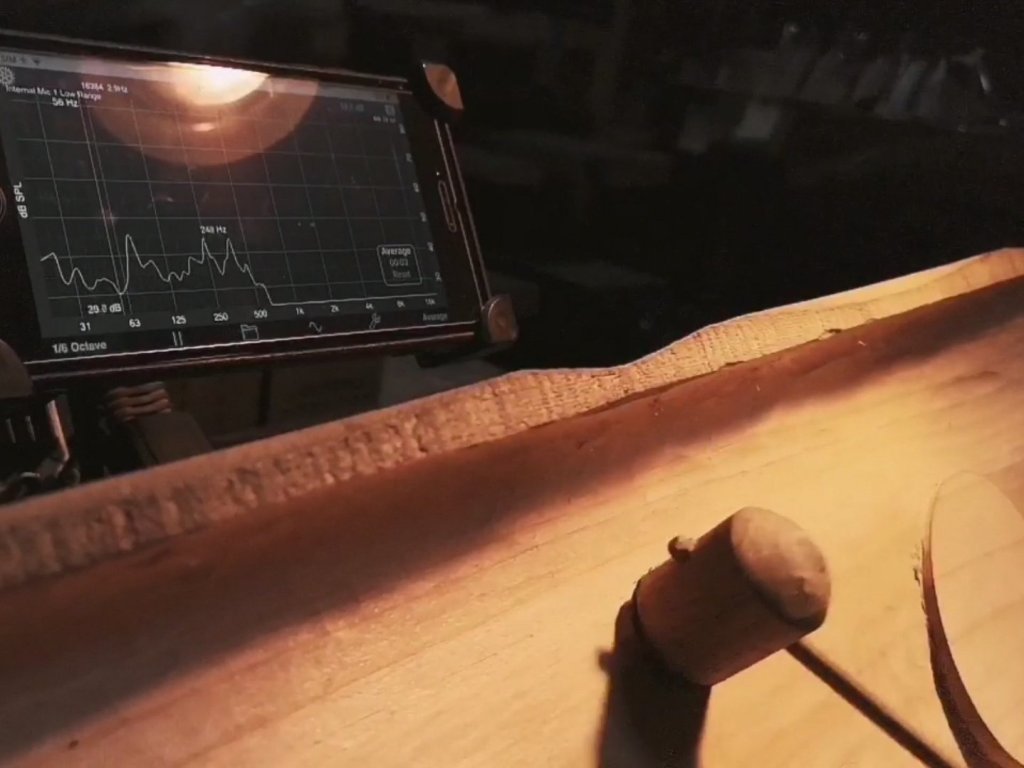
對於蕉葉琴特殊的外形約束下,古琴面板的厚薄分佈既要基於古琴獨有的諧振框架,更要因應蕉葉琴複雜外形而相應做出變化。簡單理解就是因應外形變化而調整琴腔內部的厚薄分佈,且有別常規直邊(無波浪)的琴體內部的調音方案以及諧振設計。
而在古琴面板調音方案裡,會因應調音師不同的操作經驗、音色取向、理解深度等而有所不同,更甚至是各家秘而不宣的獨門奧秘。但這一切都離不開最基本的樂器製作規範以及的樂理機制,更是關於聽感的一門綜合考量。
相對地,蕉葉琴面板調音可以以D調作為其面板主基調,因應絲弦或鋼弦不同拉力極限從而延申出正調A=416-440Hz範圍。而面板的響應頻率則可以在69.4-76Hz之間或更低的48Hz區段,而在合琴後進一步對面板外形進行微修從而校準到71.1-73.3Hz。而常規的古琴在合琴後不能微修外形情況下,調音則需要在合琴前加大其音準偏移量。
Soundboard fine tunning of the Jiaoye Qin
Under the special shape constraints of the Jiaoye Qin, the thickness distribution of the Qin soundboardl must be based on the resonance frame of the Qin, but also change accordingly in response to the complex shape of the Jiaoye Qin. A simple understand is to adjust the thickness distribution inside the soundboard cavity in response to changes the outside shape, and there are different tuning project and resonance designs inside the regular straight Qin body (but the wave shape).
In the Qin soundboard fine tuning statge, it will be different according to different Luthier’s tuning experience, timbre orientation, depth of understanding, etc. and even the various secrets tech in each genre. But all of this is inseparable from the most basic musical instrument making standards and musical theory mechanisms, and it is a comprehensive consideration of the sense of hearing.
In contrast, the Jiaoye Qin’s soundboard fine tuning can use D as its main pitches, which extends the range of tuning A=416-440Hz in response to the different tension limits of silk or steel strings. The response frequency of the sounboardl can be in the range of 69.4-76Hz or the lower 48Hz range. After the whole shape was further modified to calibrate to 71.1-73.3Hz. However, if Qin can’t be fine-tuned in outsice after the soundboard and backboard sticked, the soundboard tuning needs to increase its intermodulation offset pitch before.
 {紫雲古琴斵製技藝坊}The Guqinuthiery & Workshop. Since 2014.