

2021-06-18
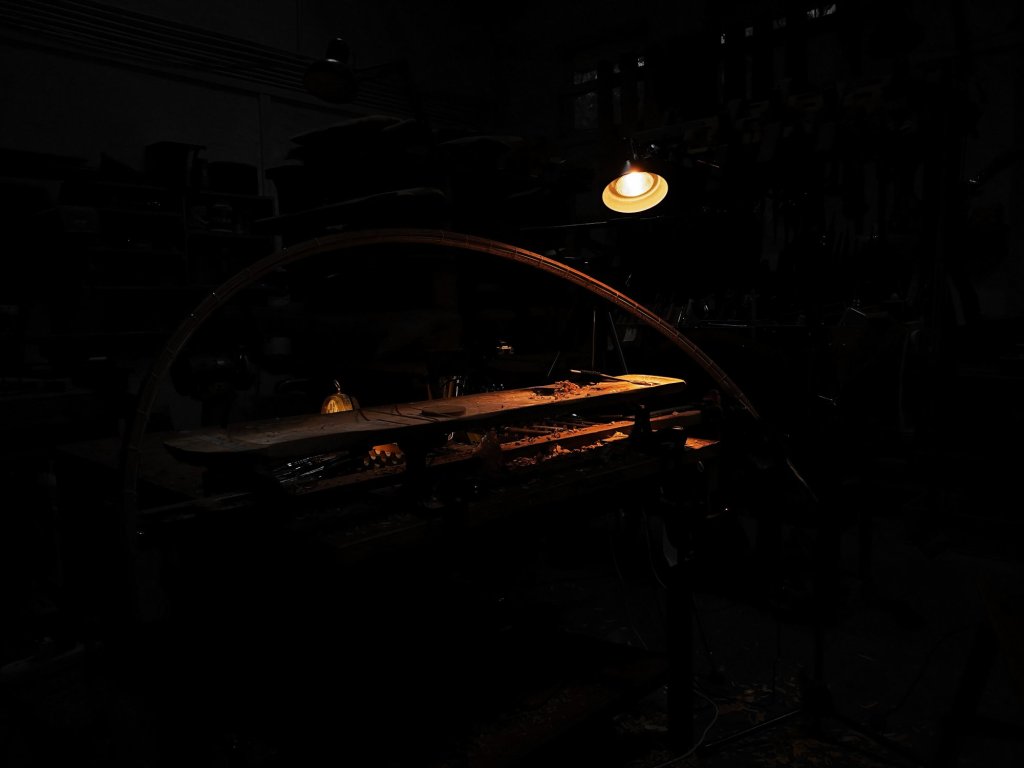
蕉葉琴面板初步調音
蕉葉琴初步調音
依照蕉葉琴自身琴體造型與最佳音色協調,對面板內部進行階段性挖薄以無限接近預期的響板音準。而內部諧振設計方案基本可以劃分為兩大類:中厚邊薄與中薄邊厚。而兩大類混合使用又衍生出高低、半坡、波浪、竹節、龍脊、蜂窩、龜甲、百納、魚鱗等多種結構形態。
古琴調音的操作方法與西方的小提琴、吉他等弦樂器調音大同小異,皆需要調試與匹配響板與背板之間的最佳音調。尤其是諧振聚攏區域劃分為主副分工,在古琴發聲結構裡稱之為“納音”而在小提琴與吉他裡稱之為“音梁”。而古琴發聲設計中也有類似於小提琴的音柱,但因應響板音調高低調整情況而定,可以按情況省免不加。
需要注意的是古琴調音的步驟與邏輯中,先定納音的對應形狀與高度,劃分龍池與鳳沼的兩大震動區域,再細分琴頭頸、琴腰、琴尾,以三大節點各自的深淺厚薄與過渡坡度進行面板的整體與局部沉降。
Soundboard preliminary tuning of Jiaoye Qin
According to the Jiaoye Qin’s shape and the best tone coordination, the interior of the soundboard is gradually thinned to infinitely approach to the expected pitch. The internal resonance design can basically be divided into two types: Thick middle and thin sides or thin middle and thick sides. The mixed use of the two types has derived a variety of structural forms such as high and low, half slope, waves, bamboo joint, dragon spine, honeycomb, tortoise shell, fish scale and so on.
The tuning method of Guqin is similar to the tuning of instruments such as violin and guitar in the West. Both need to adjust and match the best tone between the soundboardand the backboard. In particular, the resonant gathering area is divided into main and auxiliary part, which are called “Nayin" in the vocal structure of Guqin similar the “bass bar" in violin or guitar. The sounding design of Guqin also has a “Yinliang" similar to violin’s “soundpost" , but it depends on the tone adjustment of the soundboard, which can be according by the situation.
What needs attention is the steps and logic of Guqin tuning, first determine the corresponding shape and height of the “Nayin", second divide the two major vibration areas of “Longchi" and “Fengzhao", and then subdivide the respective depths of three nodes of the head and neck, the waist, and the tail. The soundboard’s whole and part settlement are based on the respective depth and thickness of the three major nodes and the transition slope.
 {紫雲古琴斵製技藝坊}The Guqinuthiery & Workshop. Since 2014.