
2021-05-09
蕉叶琴岳山镶嵌与承露钻孔
Jiaoye Qin’s Yueshan embedding and string eyes drilling
古琴的嶽山和承露承載著琴弦的拉力,也是將弦擺動時的動能傳導到琴身轉化為聲音的重要部件之一。所以嶽山與承露的厚薄、密度、乃至綜合勁度係數都顯著影響著古琴的散、按、泛三種音色。
而古琴七根弦的泛音精度取決於嶽山鑲入琴面的垂直度,所以在嶽山與承露鑲嵌前的弦路規劃與凹槽雕刻尤其講究操作精度。
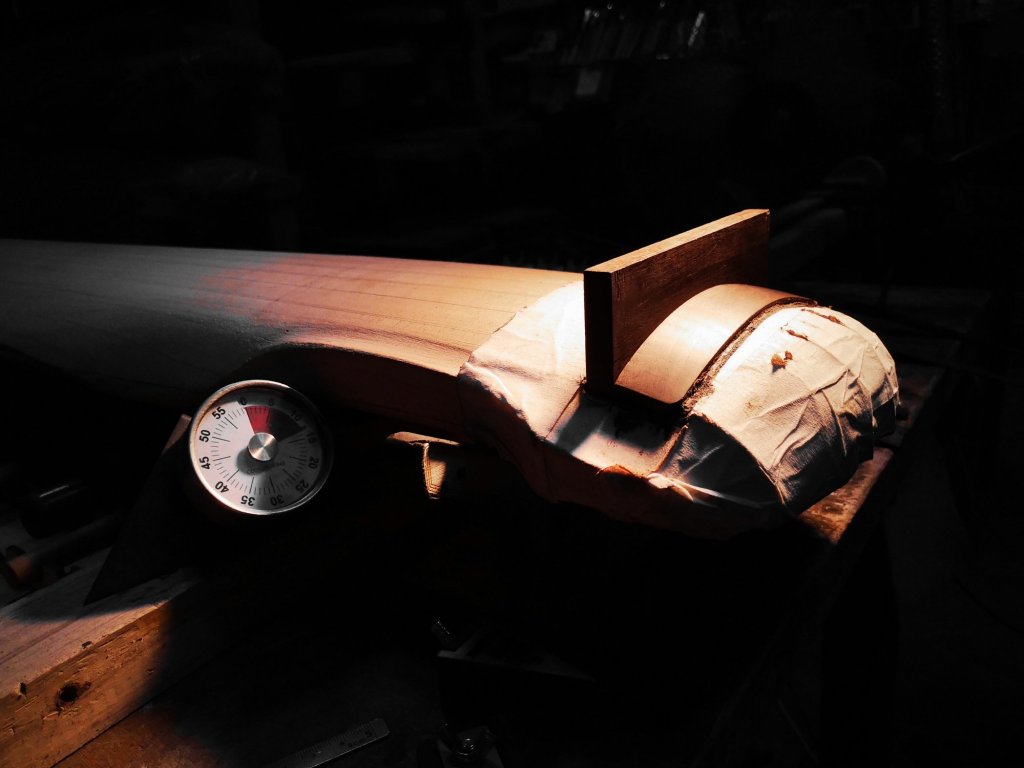
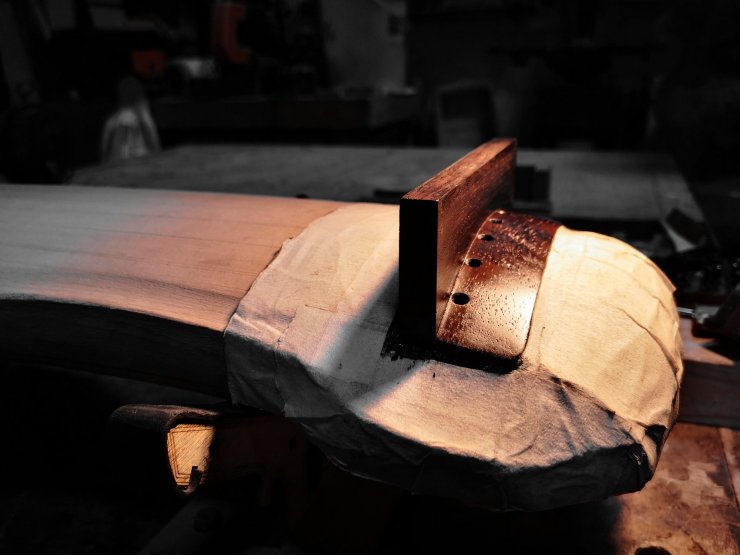
其中嶽山與承露的裝嵌需要錯開兩個階段,承露裝嵌穩固後(大概需要十日)開始銼修其弧面並使其與琴頭弧度協調且與整體匹配。以嶽山中心點對開規劃七個弦眼間隔,並拔出臨時固定的嶽山進行承露的垂直鑽孔,後再正式鑲入嶽山。
到這裡琴弦主要配件的鑲嵌精度決定了整張琴音色表現的近三分一比重,更是古琴製作中精度要求最高階段之一。
Guqin’s Yueshan and Chenglu carrying the pulling force of the strings, and also one of the key parts that transmit the kinetic energy of the string to the soundboard and transfer into sound. Therefore, the thickness, density, and even the overall stiffness coefficient of Yueshan and Chenglu significantly affect the three timbres of Guqin: harmonic, open string, and stopped sound.
The Qin’s harmonic accuracy of the seven strings it depends on the verticality of Yueshan inlaid into the soundboard surface, so the string path planning and groove carving before the Yueshan and Chenglu embedding pay a highly attention to the operation accuracy.
Among them, the embedding of Yueshan and Chenglu needs to be staggered in two stages. After the embedding of Chenglu is stable after 10 days, start to file low and fix the curved surface and make it coordinate of the curvature with Qin’s head and match the whole body. Plan seven string eyes (holes) points apart from the center of Chenglu, and pull out the temporarily embedding Yueshan, then vertical drill in Chenglu, then embed the Yueshan formally.
At this stage, the embed accuracy of the main parts of the strings determines the nearly one-third of the timbre performance of the entire Qin, and it is also one of the stages with the highest accuracy requirements in the Guqin making.
 {紫雲古琴斵製技藝坊}The Guqinuthiery & Workshop. Since 2014.